Great gameplay and impressive visuals are only part of what makes a memorable video game. Sound effects bring every action to life, guide players through the experience, and create the emotional impact that keeps them immersed from beginning to end.
For indie developers, every production choice matters. Choosing the right video game sound effects can instantly elevate a game, making even a small project feel polished, immersive, and professionally produced. High-quality audio assets also accelerate production by reducing the need to create every sound from scratch while maintaining a consistent audio identity throughout the game.
Whether you're developing a sci-fi shooter, a survival horror game, a fantasy RPG, a strategy title, a platformer, or an open-world adventure, selecting the right sound effects for video games is an essential part of the development process. Every genre relies on a unique sonic palette to support gameplay, reinforce player feedback, and strengthen worldbuilding.
In this guide, you'll discover why sounds matter, the main categories of game sound effects, how to choose the right sounds for different game genres, the most common sound design mistakes to avoid, and how professional sound effect packs can help indie developers create more immersive games while saving valuable production time and budget.

Table of contents:
- Why sound effects matter in video games
- The main categories of video game sound effects
- How to choose sound effects by game genre
- How indie developers use sound effect libraries
- Common sound design mistakes to avoid
- Where to find high-quality video game sound effects
- Conclusion
Why sound effects matter in video games
Every sound in a video game serves a purpose. Beyond creating atmosphere, sound effects help players understand their environment, react to gameplay events, and become emotionally invested in the experience. Whether it's a subtle footstep, a weapon impact, a UI notification, or a distant environmental ambience, every sound contributes to how players perceive and interact with the game world.
For indie developers, sound effects are also an efficient way to increase production value without significantly increasing development costs. Well-designed audio can transform simple visuals into believable environments, reinforce storytelling, and make every interaction feel more responsive and satisfying.
Different genres naturally rely on different types of sound effects. A sci-fi shooter uses futuristic interfaces and energy weapons, while a fantasy RPG depends on magical spells, medieval weapons, creature vocalizations, and immersive ambiences. Horror games build tension through unsettling soundscapes, whereas strategy and simulation games require clear audio feedback to communicate information efficiently.
Understanding these different roles helps developers build more immersive games while choosing sound libraries that genuinely support their gameplay and artistic direction.
Gameplay feedback and player actions
One of the primary roles of sound effects is to provide immediate feedback for the player's actions. Every interaction should generate a clear and recognizable audio response, helping players understand the consequences of what they have just done without relying entirely on visual information.
Simple actions such as picking up an item, opening a door, reloading a weapon, activating a switch, completing a quest, or navigating a menu become far more satisfying when paired with appropriate audio feedback. Well-designed UI sound effects also improve inventory management, menu navigation, notifications, and HUD interactions by making interfaces feel responsive and intuitive.
During gameplay, sound cues also communicate important information. In FPS games, footsteps, gunfire, explosions, or reload sounds allow players to anticipate nearby threats. Strategy games rely on alerts, confirmations, and notifications to help players manage multiple events simultaneously, while platformers often use distinct sounds to reinforce jumps, collectibles, hazards, and successful actions.
For this reason, effective gameplay feedback should always be clear, short, immediately identifiable, and never fatiguing to hear repeatedly.

Building the game world through sound
Sound does much more than accompany gameplay—it gives life to the world itself. Long before players consciously notice individual sound effects, they absorb countless subtle audio details that define the atmosphere of each location.
Environmental ambience, weather effects, wildlife, machinery, room tones, distant activity, and background textures all help establish the identity of a place. A dense forest, an abandoned bunker, a futuristic laboratory, or a medieval dungeon each require a completely different sonic palette to feel believable.
Likewise, every game genre develops its own audio language. Science-fiction games rely on computer interfaces, drones, robotic machinery, and energy systems, while fantasy games combine magical effects, enchanted environments, medieval weapons, and mythical creatures. Horror games often use silence, distant noises, organic textures, and unsettling ambiences to create anticipation long before danger appears on screen.
Professional sound effect libraries help indie developers create these rich soundscapes without recording every element from scratch, making it easier to maintain a consistent audio identity throughout the project.
Readability and player guidance
Beyond immersion and atmosphere, sound also improves clarity. Well-designed audio guides the player's attention, highlights important gameplay events, and reduces dependence on visual information.
Players constantly use sound to locate enemies, identify hazards, distinguish between friendly and hostile actions, recognize objectives, and understand changes occurring outside their field of view. In complex gameplay situations, audio often communicates information faster than visuals alone.
Good sound design also contributes to accessibility by reinforcing gameplay mechanics through multiple sensory channels. Carefully balanced audio cues help prevent information overload while ensuring that the most important sounds remain easy to recognize, even during intense combat or crowded scenes.
Ultimately, successful game audio is not about filling every moment with sound. It is about delivering the right information at the right moment, allowing players to remain fully engaged without overwhelming their senses.
The main categories of video game sound effects
Every video game relies on a combination of sound effect categories that work together to create immersion, reinforce gameplay, and shape the player's experience. While every genre has its own audio requirements, most games share the same core families of sound effects, from interface sounds and environmental ambience to combat, creatures, and character interactions.
Understanding these categories helps indie developers build a more coherent audio pipeline, choose the right sound libraries for their project, and identify the assets they need during production.
The following sections introduce the main categories of video game sound effects and explain how each one contributes to gameplay, immersion, and worldbuilding.

UI sound effects
User interface sound effects may seem subtle, but players hear them hundreds of times during a single gaming session. Every menu navigation, inventory action, notification, or confirmation relies on audio feedback to make the interface feel responsive and intuitive.
This category includes button clicks, confirmation tones, warning alerts, achievement notifications, error messages, inventory sounds, quest updates, HUD interactions, and other interface feedback. These sounds help players understand their actions instantly without relying solely on visual cues.
Clear interface sounds are particularly important in strategy, simulation, management, and mobile games, where players constantly interact with menus and on-screen information. Effective UI audio should be short, easily recognizable, and pleasant enough to remain unobtrusive during long play sessions.
Some genres also develop their own interface language. Science-fiction and cyberpunk games, for example, often replace traditional menu sounds with futuristic computer interfaces, holographic controls, digital notifications, radar scans, radio communications, and system alerts that reinforce the game's technological identity while preserving clear player feedback.
A professional sound effects pack should provide a wide range of interface sounds with multiple variations, allowing developers to build responsive menus while maintaining a consistent audio identity throughout the game.

Sci-fi sound effects
Science-fiction games rely on distinctive sound design to create believable worlds and technologies. Whether the setting is a distant planet, a cyberpunk megacity, a military spaceship, or a dystopian research facility, sound helps define the identity of the game's universe and supports both immersion and gameplay.
This category includes sci-fi sound effects such as energy weapons, spacecraft engines, computer interfaces, onboard systems, AI voices, radio communications, drones, robotic movements, alarms, electronic signals, and system alerts. These sounds reinforce the atmosphere while also providing valuable gameplay feedback.
Sci-fi sound effects are widely used in space exploration games, cyberpunk adventures, mecha games, FPS titles, strategy games, and many other futuristic or speculative settings. They also contribute to environmental storytelling by giving research laboratories, orbital stations, abandoned spacecraft, or high-tech cities their own distinctive sonic identity.
Choosing a comprehensive sci-fi sound effects library allows indie developers to build a consistent audio identity while reducing production time and ensuring every interaction feels coherent throughout the game.

Mechanical and industrial sound effects
Mechanical sound effects are used to recreate the sounds of machinery, engines, hydraulic systems, metallic mechanisms, factory equipment, and other industrial environments. They help developers give weight, movement, and realism to everything from heavy doors and elevators to generators, conveyor belts, and automated systems.
This category is widely used in factory-building games, simulation games, steampunk adventures, dystopian settings, science-fiction titles, and robotics-focused projects. Combined with environmental ambience and technology sound effects, mechanical sound effects help create believable industrial spaces and reinforce the identity of each location.
Professional sound libraries typically provide multiple variations together with high-quality recordings and designed mechanical sound effects for gears, pistons, chains, levers, engines, and other mechanical elements. Using varied recordings helps prevent repetitive audio while maintaining a consistent and convincing soundscape throughout the game.

Creature and horror sounds
Creature and horror sound effects help give life to monsters, supernatural entities, fantasy creatures, aliens, mutated lifeforms, and other non-human characters. Whether the goal is to build slow-burning tension, support intense combat, or reinforce exploration, sound plays a central role in shaping the player's emotional experience.
Growls, breathing, screams, footsteps, attacks, movement sounds, and environmental audio cues help establish the presence of unseen threats while giving each creature its own distinctive identity. Combined with carefully designed ambience, these sounds can create anticipation, encourage caution, or increase the intensity of an encounter.
Creature sound effects are widely used in survival horror, psychological horror, fantasy RPGs, science-fiction adventures, monster-hunting games, and boss encounters. Well-designed sound libraries typically provide multiple variations of vocalizations, movements, impacts, and interaction sounds, allowing developers to create more believable creatures while avoiding repetitive audio throughout the game.

Combat and destruction sound effects
Combat sound effects do much more than make battles feel powerful—they provide essential gameplay feedback. Every gunshot, sword clash, explosion, shield impact, or reload helps players understand what is happening around them while making combat more responsive and satisfying.
This category includes firearms, melee weapons, energy weapons, reloads, weapon handling, bullet impacts, ricochets, explosions, armor and shield impacts, debris, collapsing structures, and environmental destruction. Together, these sounds communicate attacks, damage, movement, and the consequences of combat while reinforcing the overall intensity of each encounter.
Combat and destruction sound effects are essential for FPS games, action-adventure titles, tactical shooters, hack-and-slash games, mecha games, and large-scale battle simulations. Beyond supporting gameplay, they also strengthen environmental storytelling by making damaged buildings, destructible objects, and large-scale action sequences feel more convincing.
Professional sound libraries typically provide multiple variations for each type of sound, allowing developers to randomize playback and reduce repetition. Layering different recordings, for example combining a weapon shot with mechanical elements, environmental reflections, or debris also creates richer, more believable combat audio without making repeated actions sound identical.

Ambience and environmental sound effects
Environmental sound effects establish the atmosphere and identity of a location. Rather than responding directly to player actions, they create a believable sonic backdrop that helps players understand where they are and what is happening around them.
This category includes room tones, forests, caves, cities, industrial environments, rivers, oceans, wind, rain, snow, waterfalls, birds, insects, distant machinery, wildlife, and other background sounds that give each environment its own character.
Environmental audio plays a major role in open-world games, adventure titles, survival games, RPGs, and exploration-based experiences. A location should sound different depending on its geography, weather conditions, time of day, or level of activity. Rich environmental soundscapes make virtual worlds feel larger, more believable, and more immersive.
Dedicated ambience libraries usually provide long recordings and multiple variations that help developers build layered soundscapes while reducing repetition during extended gameplay sessions.

Foley and movement sound effects
Foley sound effects are directly linked to the player's movements and interactions with the game world. Unlike environmental ambience, they respond to character actions and provide immediate feedback during gameplay.
This category includes footsteps on different surfaces, clothing movement, equipment handling, backpacks, weapon handling, object interactions, climbing, jumping, ladders, doors, switches, pickups, and other character actions.
Well-designed foley helps players distinguish between different materials and surfaces, reinforces movement, and makes every interaction feel more natural. Walking through mud, crossing a metal walkway, opening a heavy wooden door, or picking up an object should all produce distinctive audio cues that reinforce the physicality of the game world.
Specialized foley libraries typically offer multiple variations for each action, allowing developers to randomize playback and avoid repetitive sounds during long gameplay sessions.

How to choose sound effects by game genre
Every game genre has its own audio requirements. Choosing the right video game sound effects is not simply a matter of selecting high-quality recordings—it is about supporting gameplay mechanics, reinforcing the game's atmosphere, and creating a consistent player experience.
The most effective sound effects are not necessarily the most realistic. A stylized platformer, a retro-inspired RPG, a low-poly survival game, and a photorealistic military shooter all require very different sound design approaches. Even an excellent sound effect can feel out of place if it does not match the visual style, tone, or identity of the game.
Rather than searching for the "best" sounds, developers should build a coherent sonic palette that supports both gameplay and worldbuilding. The following sections explore some of the most common game genres and the types of sound effects that best suit their mechanics, atmosphere, and artistic direction.

Sci-fi and cyberpunk games
Science-fiction and cyberpunk games rely on sound design to establish advanced technologies and futuristic environments. From spaceship engines and robotic movements to holographic interfaces and AI systems, every sound contributes to the player's perception of a believable world.
Developers typically use sci-fi sound effects such as energy weapons, computer interfaces, AI voices, radio communications, drones, radar systems, alarms, and robotic movements. Together, these sounds reinforce the game's technological identity while providing clear gameplay feedback during exploration and combat.
Games inspired by futuristic cities, space exploration, or mecha combat also benefit from combining robot sound effects, mechanical sound effects, and interface sounds. Together, these layers create a distinctive sonic identity that helps players immediately recognize the game's universe while strengthening immersion throughout the experience.

Fantasy and RPG games
Fantasy and RPG games rely on sound design to bring magical worlds, mythical creatures, and medieval environments to life. Magic sound effects, creature vocalizations, medieval weapons, enchanted objects, and environmental ambience all contribute to creating believable worlds while supporting exploration, combat, and storytelling.
Whether the game features high fantasy, dark fantasy, or medieval adventures, choosing fantasy sound effects libraries that match the project's artistic direction helps create a coherent sonic identity while reinforcing the atmosphere and identity of the game world.

Horror and survival games
In horror and survival games, sound design is often more powerful than visuals when it comes to creating fear and suspense. Subtle environmental sounds, distant noises, unsettling creature vocalizations, and carefully placed moments of silence help build anticipation, making moments of danger even more impactful.
Developers typically combine creature vocalizations, environmental ambience, footsteps, breathing, organic textures, and carefully placed audio cues to build tension. Carefully designed soundscapes can suggest danger, encourage exploration, or make players question what lies ahead.
Games featuring monsters or alien lifeforms also benefit from expressive creature sound effects. Growls, screams, footsteps, attacks, and movement sounds help give each enemy a distinctive identity while also communicating valuable gameplay information. Players can often recognize the type of creature, estimate its distance, anticipate an incoming attack, or identify whether it is searching, patrolling, or reacting to the player's presence simply by listening. A varied sound library helps prevent repetition while making encounters feel more dynamic and unpredictable throughout the game.

FPS and action games
Fast-paced action games rely on sound effects that are clear, responsive, and informative. Every gunshot, reload, explosion, impact, or weapon interaction should provide immediate feedback while helping players understand what is happening on the battlefield.
Essential combat sound effects include firearms, melee weapons, energy weapons, reloads, weapon handling, charging sounds, bullet impacts, ricochets, explosions, debris, and, in science-fiction settings, shield impacts. Together, these sounds communicate the direction of threats, the type of weapon being used, the timing of player actions, and the consequences of each attack.
Clear audio cues also help players locate enemies, anticipate incoming attacks, distinguish between different weapons, and identify impacts on various surfaces, even before those events become visible on screen. This combination of spatial awareness and immediate feedback plays a major role in both gameplay readability and player performance.
Professional weapon sound effects libraries typically provide multiple variations for weapon sounds and impacts, allowing developers to randomize playback and avoid repetitive combat audio. Layering complementary recordings also helps create more convincing and responsive combat without making repeated actions sound identical.

Strategy and simulation games
Strategy and simulation games place a strong emphasis on clarity and consistency. Players constantly interact with menus, issue commands, monitor multiple systems, and manage large amounts of information, making clear audio feedback essential for smooth gameplay.
Well-designed UI sound effects help confirm player actions, highlight important events, communicate warnings, and make complex interfaces easier to navigate without becoming intrusive. As matches or simulation sessions often last for extended periods, interface sounds should remain clear, recognizable, and comfortable to hear repeatedly.
Beyond interface audio, many strategies and simulation games also rely on environmental and mechanical sound effects to bring their worlds to life. Factory machinery, construction equipment, vehicles, industrial systems, weather, crowds, or city ambiences all contribute to making the game world feel active while supporting the overall atmosphere.
Using a consistent set of interface sounds, notifications, alerts, and confirmation cues helps developers improve gameplay readability while creating an interface that remains responsive and intuitive throughout long play sessions.

Open-world and adventure games
Open-world and adventure games rely on sound design to make large environments feel alive and encourage exploration. Whether players are travelling through forests, cities, mountains, deserts, or ancient ruins, environmental audio helps define each location while reinforcing the game's atmosphere and artistic direction.
Environmental sound effects such as wind, flowing water, wildlife, weather, distant activity, and ambient textures create a sense of place and continuity throughout the world. Rather than responding directly to player actions, these sounds establish the identity of each environment and make exploration feel more engaging.
Foley sound effects complement these ambiences by responding to the player's movements and interactions. Footsteps across different surfaces, climbing, object interactions, equipment handling, and other character actions provide immediate feedback while reinforcing the physicality of the world.
Because exploration often lasts for dozens of hours, developers benefit from using multiple sound variations and layered recordings to reduce repetition. A varied soundscape helps each environment remain distinctive while supporting a consistent audio identity throughout the game.
How indie developers use sound effect libraries
Professional sound effect libraries have become an essential resource for many indie developers. Beyond saving time, they simplify audio production, improve workflow organization, and provide access to a wide range of sounds suited to different genres and gameplay needs.
Why developers use sound libraries
Creating every sound effect from scratch is rarely practical for independent developers. Many professional sound libraries give developers access to a wide range of audio assets that can significantly reduce production time while supporting different gameplay situations and artistic styles.
Rather than replacing sound design, these libraries provide a foundation that developers can adapt to their own projects. The final audio experience still depends on sound selection, mixing, variations, implementation, and the overall artistic direction of the game.
Instead of spending valuable time recording, editing, and organizing every sound manually, developers can focus on gameplay, level design, programming, and audio implementation while building a consistent soundscape throughout development.

Organizing and integrating sound libraries
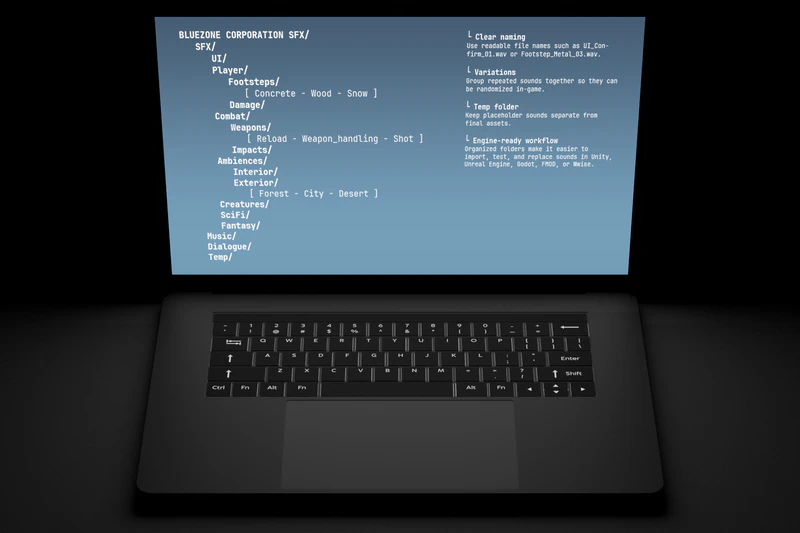
A well-organized sound library can save considerable time throughout production. Clear file names, logical folder structures, searchable categories, and consistent naming conventions make it much easier to locate the right sound effect as a project grows.
Most indie developers begin by using the audio systems built directly into game engines such as Unity, Unreal Engine, or Godot. As projects become more complex, some teams also use dedicated audio middleware such as FMOD or Wwise to manage interactive audio, sound variations, and more advanced behaviors.
Choosing a library that is easy to browse and integrate into existing workflows can simplify audio production from prototyping to release.
Saving time and budget
Independent studios often work with limited budgets and small development teams. Using professional sound effect libraries is usually more efficient than creating every sound from scratch, allowing developers to focus their time and resources on other aspects of production.
Depending on the library, developers can access either specialized collections dedicated to a specific theme or larger libraries covering multiple categories such as combat, interface sounds, environmental ambience, creatures, or mechanical effects. Some libraries provide highly designed sound effects that can be integrated directly into gameplay, while others offer clean recordings intended to be layered, processed, or adapted during sound design.
Although a sound library does not create a complete soundscape on its own, it provides a solid foundation that developers can build upon. The result still depends on sound selection, implementation, mixing, variations, and how audio interacts with music, dialogue, and gameplay systems.
By reducing the time spent recording, editing, and organizing audio assets, developers can dedicate more resources to gameplay, level design, balancing, bug fixing, and polishing the final release.
Building a consistent audio identity
Consistency is one of the foundations of effective sound design. Even high-quality sound effects can feel out of place if they do not match the game's artistic direction or audio style. For example, highly realistic weapon sounds may clash with a stylized or low-poly game, while exaggerated cartoon effects can feel out of place in a dark, atmospheric experience.
Using sound effects from a coherent library helps developers maintain consistent audio identity across interface sounds, environments, combat, and gameplay interactions. This consistency improves gameplay readability, reinforces the game's atmosphere, and creates a more cohesive experience for players.
As a project grows, maintaining a consistent sound palette also makes it easier to introduce new content without creating noticeable differences in tone, loudness, or overall audio style.
Choosing the right library
Not every sound library is suitable for game development. Before investing in audio assets, developers should consider not only sound quality but also how easy the library is to use within their production workflow.
Depending on the project, some libraries offer highly designed sound effects that are ready to integrate into gameplay, while others provide clean recordings that can be edited, layered, or processed to match a specific artistic direction. For sounds such as ambience, weather, or environmental recordings, longer files are often preferable as they create more natural and less repetitive soundscapes.
Audio quality also matters. Libraries that provide high-resolution files (for example 24-bit / 96 kHz) offer greater flexibility for editing and sound design, helping preserve audio quality when sounds are heavily processed.
Finally, developers should always review the license before using a library in a commercial project. A good license should clearly specify whether the sound effects can be used in published games, trailers, demos, DLC, and future updates, while also explaining any restrictions on redistributing the original audio files or sharing the library within a team.
Whether choosing a specialized collection for sci-fi sound effects, interface sounds, weapon sound effects, or environmental audio, selecting a library that matches both the technical and creative needs of the project will save time throughout development.
Common sound design mistakes to avoid
Even high-quality audio assets can lose their effectiveness when used incorrectly. Avoiding common sound design mistakes helps improve gameplay readability, maintain a consistent audio identity, and ensure that sound effects communicate the right information at the right moment.

Poor audio feedback
Players use audio cues alongside visuals and animations to understand and confirm their actions. Missing or unclear sound cues can make menus, combat, exploration, and interactions feel less responsive, while reducing the clarity of important gameplay feedback.
Every important action should produce immediate and recognizable feedback. Well-designed video game SFX improve gameplay readability and make interactions more satisfying.
Repetitive sounds
Hearing the exact same sound dozens of times quickly becomes noticeable and can make gameplay feel repetitive or less polished. This issue is particularly noticeable with footsteps, gunshots, creature vocalizations, and interface sounds.
Many professional sound effect libraries provide multiple variations for commonly repeated sounds, allowing developers to randomize playback and create more natural and less predictable audio experiences.
Inconsistent loudness and mixing
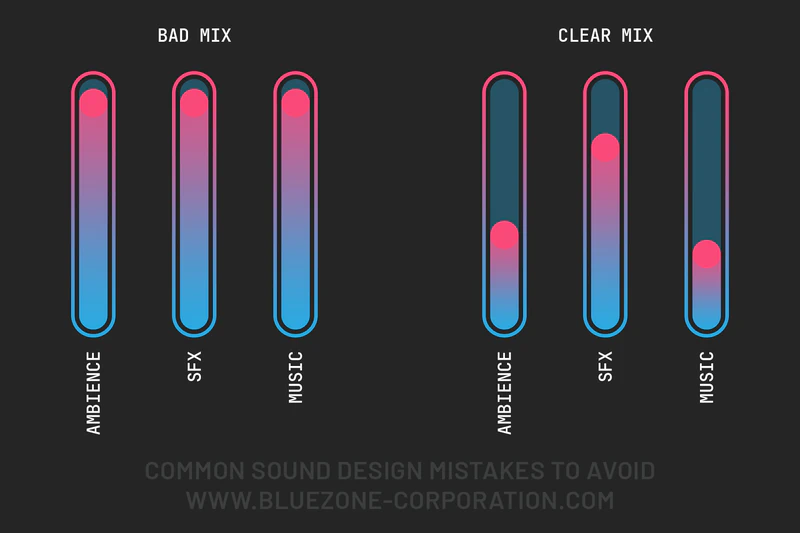
Even well-designed sound effects can become ineffective if volume levels are not properly balanced. Sounds that are too loud may mask important gameplay information, while sounds that are too quiet can easily go unnoticed.
A common mistake is allowing too many sounds to compete for the player's attention at the same time. Loud explosions, music, ambience, interface sounds, and gameplay cues should all be carefully balanced so that the most important information remains easy to recognize.
A clear audio hierarchy improves gameplay readability, reduces listening fatigue, and helps players react more quickly to important events throughout the game.
Ignoring environmental audio
Environmental sound effects often receive less attention than combat audio, yet they play a fundamental role in making game worlds feel believable. Even highly detailed environments can feel empty if they lack appropriate ambient sound.
Environmental audio includes nature sound effects, weather, room tones, wildlife, distant activity, and other ambient details that define the identity of a location. These sounds help create tension, curiosity, calm, isolation, or a sense of danger, depending on the game's atmosphere and artistic direction.
Where to find high-quality video game sound effects
Finding the right sound effects is not only about audio quality. Developers should also consider licensing, consistency, organization, and how easily a library fits into their production workflow. Whether using free resources or professional collections, choosing reliable audio sources can save valuable development time while helping maintain a coherent sound design.
Free sound effects vs professional sound libraries
Free sound effects can be an excellent resource, particularly for prototypes, game jams, or small independent projects. Many high-quality free libraries are available online and can provide valuable assets when used under the appropriate license.
However, relying on multiple free sources can also introduce challenges. Recording quality, file organization, naming conventions, and licensing terms often vary from one provider to another. Developers may also spend considerable time searching for matching sounds or combining assets that do not share the same audio style.
Professional sound effects packs generally offer more consistent organization, clearer licensing, and collections designed around specific themes or gameplay needs. Rather than replacing free resources, they can provide a reliable foundation for projects that require a cohesive audio identity.
What to look for in a sound library
Choosing a sound library is about more than audio quality alone. A library should be easy to use, fit your production workflow, and provide clear licensing for commercial game development.
Before making your choice, consider the following points:
- Commercial license: Make sure the license clearly allows the use of sound effects in published games, demos, trailers, DLC, and future updates. Also check any restrictions regarding redistribution or team usage.
- Technical quality: Look for high-quality audio formats (such as WAV) that provide enough flexibility for editing and implementation.
- File organization: Clear file names, logical categories, and well-structured data sheets make it easier to find and manage assets throughout development.
- Sound variations: Some SFX libraries include multiple variations for frequently repeated sounds, helping reduce repetition during gameplay when appropriate.
- Environmental recordings: Long ambience recordings are often preferable for outdoor environments, interiors, or atmospheric locations, as they help create more natural and less repetitive soundscapes.
- Workflow compatibility: Libraries should be easy to integrate into common game development workflows using engines such as Unity, Unreal Engine, or Godot, whether developers use the engine's built-in audio tools or middleware such as FMOD or Wwise.
Choosing a pack that meets both the technical and practical needs of your project will save time throughout development and make audio implementation considerably easier.
Recommended categories for indie games
The most useful sound effect categories depend on the type of game being developed. Rather than trying to build an exhaustive collection, indie developers should prioritize the audio assets that best support their gameplay mechanics, artistic direction, and production needs.
For most projects, UI sound effects, foley sound effects, and environmental ambience provide the foundation of a clear and believable audio experience. Combat-focused games typically require weapons, impact, and destruction sound effects, while science-fiction projects often rely on sci-fi, mechanical, and robot sound effects. Fantasy and horror games benefit from creature vocalizations, magic sound effects, and expressive environmental audio that reinforce the atmosphere of the game world.
Selecting sound libraries according to the specific needs of the project allows developers to invest their time and budget more effectively while building a coherent audio identity that can evolve alongside the game.
Conclusion
Great sound design does far more than enhance gameplay—it helps players understand the game, reinforces its artistic direction, and brings virtual worlds to life. Whether you're developing a small indie project or a larger production, choosing the right sound effects is only the first step. Their effectiveness ultimately depends on how they are selected, implemented, mixed, and combined with gameplay, visuals, music, and player interactions.
Professional sound libraries can provide a valuable foundation by reducing production time and giving developers access to high-quality audio assets. Combined with thoughtful implementation and a coherent audio strategy, they allow indie teams to build richer, more consistent soundscapes while focusing their efforts on where they matter most.
Ultimately, successful game audio is not about using the largest sound library or the most realistic recordings. It is about choosing the right sounds for the right game and using them to create an experience that feels coherent, responsive, and memorable from the first interaction to the final scene.
Want to see more of our content in Google? Add us to your Preferred Sources.