


Drop a pitched-down lion roar over a close-up of an alien creature breathing in the dark, and the illusion falls apart on the first frame. Everybody spots the big cat right away, and nothing in that file connects to the wet ribs or clicking mandibles on screen.
In creature sound design, you often start from real recordings and reshape them until they take on a new biological job. Here's how creature sounds are made for film, TV, and games, in five studio steps: defining body and behavior, recording raw sources, transforming takes, layering by function and timing, and testing every cue in context.
What makes a creature sound organic?
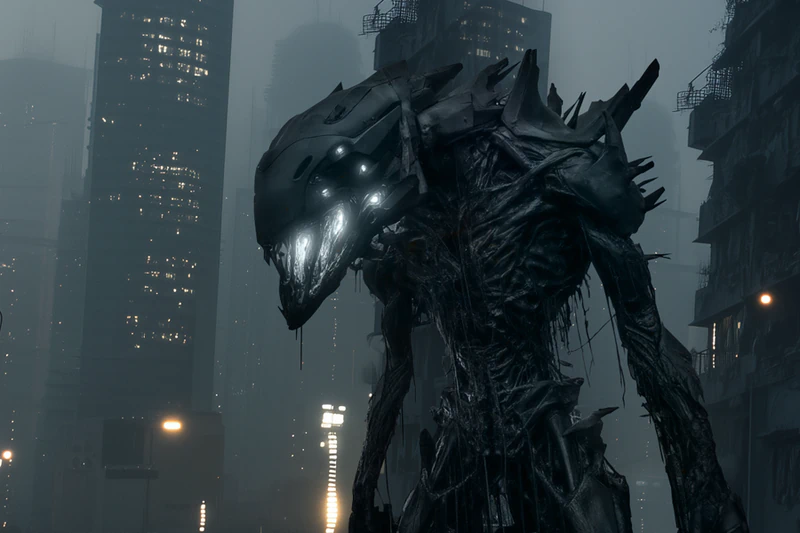
An organic creature sound evokes a biological body: the listener hears living tissue, internal structure, mass, and bodily activity. In practice, that feel depends on what the sound points to and what the ear actually picks up. The cue should suggest flesh, bone, membranes, shells, plant fibers, or fungal growth, and you should hear that living matter at work: damp friction, uneven breath, cavity resonance, or thick fluid.
Online tutorials sometimes use "organic" as shorthand for mic-recorded sources as opposed to synthesis. Putting a mic in front of a prop doesn't automatically make a creature sound alive, though, and electronic sources aren't off-limits. In our studio, hardware synthesizers supply gritty low-end beds or unstable textures under wet takes. For Organic Lifeform Textures, we paired hardware synth recordings with slimy, gelatinous, juicy, and viscous materials. On Synthetic Organic Textures, we ran Novation Ultranova, Korg R3, and Roland JD-800 recordings through granular effects and random modulation.
Organic creatures don't belong only to horror monster sound design, either. Peaceful, bioluminescent, plant-based, or hybrid lifeforms follow the same logic, as we explain in our article on how sound effects shape science fiction movies. Speaking about Avatar: Fire and Ash in January 2026, supervising sound editor Gwendolyn Yates Whittle explained that James Cameron based Pandora's creatures on real animals, so their sounds kept a "biological reality" with a twist. In a 2010 Space.com article, plant physiologist Jodie Holt suggested that Pandora's glowing flora might be an adaptation to extended darkness, and Cameron coined "plananimal" for lifeforms that blur the line between plant and animal.
Designing creature sounds for films, TV series, and video games
Film timelines and game engines ask very different things from creature sound design. Before you record a single take, figure out whether the creature will play out in a fixed, linear cut or react in real time to whatever the player does.
Films and TV series
Film and television creature sounds serve a linear sequence where every viewer gets the same shots, cuts, and angles in the same order. Even when sound and picture evolve together in post, finished breaths, weight shifts, and vocal peaks lock to the final cut.
In A Quiet Place (2018), sound designers Ethan Van der Ryn and Erik Aadahl built the creatures' clicks, breaths, and wet, crunchy exoskeleton sounds while the picture edit was still changing around them. Because the creatures hunt by sound, the mix leans on silence and at times switches to the creatures' own hearing. Van der Ryn noted that the team relied on snorting and breathing to keep the creatures "visceral and organic" in idle moments, when they're close to prey they haven't located yet.
Stranger Things Season 2 (2017) shows how linear sound design follows a creature's physical growth from scene to scene. As Dart grows from a tiny pollywog into a Demodog, sound designer Craig Henighan voiced most of the early stages himself, performing to picture through Krotos Dehumaniser instead of pulling from stock libraries. Each growth stage got a new, deeper round of vocals, and only the full Demodog brought in guttural sounds, vibrato, and familiar Season 1 Demogorgon roars.
Video games
Video game creature audio has to react to unpredictable player moves without exposing loops, a constraint we cover in our guide to video game sound effects for indie developers. You split vocals, footsteps, and impacts into variation pools by state, force, and distance so the engine can trigger them in real time.
In The Last of Us Part II (2020), Naughty Dog sound designer Beau Jimenez matched each Infected class to its stage of fungal infection. First-stage Runners used raw, unlayered human vocal takes so you can still hear the person trapped underneath, and later stages moved further away from human speech as the Cordyceps fungus took over the body. For Stalkers, Jimenez combined prepubescent clicks and sporadic, shrieking inhales with deliberate silence right after they flee to keep stealth encounters tense.
For Returnal (2021), senior sound designer Ash Read and the team at PlayStation Studios Creative Arts picked organic sources that matched each alien's mass and build, from bird shrieks for avian-skulled quadrupeds to air blown through a plastic tube into yogurt for one massive biped's deep breaths and gurgly inhales. Principal technical sound designer Simon Gumbleton and supervising sound designer Loic Couthier paired 3D spatialization with a priority-based system so critical attack cues cut clean through chaotic firefights.
Understanding the creature's body and behavior
Believable creature sound design starts with anatomy and behavior, long before you open a folder of monster roars. Once you know how an organism is built, how it moves, and why it makes noise, choosing the right studio sources gets much easier.
Anatomy and body structure
Start with physical build, because anatomy dictates what frequencies a body produces. Size and mass set your baseline: a heavy organism moves slower with harder ground hits and deeper low end, and a small one darts quickly with lighter, finer detail. Inside the torso, the airways and body cavities reinforce resonances and give grunts, breaths, or gurgles internal volume.
Bone, shell, and soft tissue shape movement cues. Two rigid plates or bones knocking together produce clicks, clacks, or snaps; a joint rubbing under load yields gritty scrapes, like the shell and claw friction you hear in Crab - Creature Sound Effects. Muscle and soft flesh reveal deformation through compression, stretching, torsion, and rebound. Bodily fluids leave their mark too: thick mucus slows motion into sticky suction and heavy bubbling, and thin liquids trickle faster. Check limb count and layout, since leg arrangement sets the order and number of ground hits.
Behavior, emotion, and communication
Every sound an expressive creature makes has a reason behind it. When you're working out how to make creature sounds feel alive, start by mapping how the organism reacts at rest, on alert, during a threat display, and in pain. A shift from curiosity to fear, aggression, or distress shows up in specific ways: levels rise or fall, sounds get shorter or longer, attacks soften or sharpen, steady breathing turns ragged, and the gaps between sounds tighten or stretch.
Keep communication separate from reflex body noise. Calls, warnings, threats, and distress cries are deliberate and meant to be heard. Involuntary reactions are quieter: a swallow, a muscle contraction, a spasm, or a forced breath reveals strain or panic without being a call.
Body movement and biological activity
Ongoing biological noise keeps a creature present even when its mouth is shut. Check locomotion first to see which body parts drive movement and how claws, pads, shells, or limbs push off the ground. Breathing gives twice the detail once you separate inhalation from exhalation: add fluid, secretions, or a vibrating membrane in the airway, and a plain breath turns into a wet rattle.
Growth, organs, and secretions round out the creature's idle sounds. Contractions and pulses sound far more natural when you vary their strength, length, and spacing instead of looping one steady beat. Mutation scenes call for tissue stretching and swelling, plus cracks, tears, and shifting matter, while viscosity sets the speed and grain of bubbling, suction, or fluid expulsion.
What an organic creature sound is made of
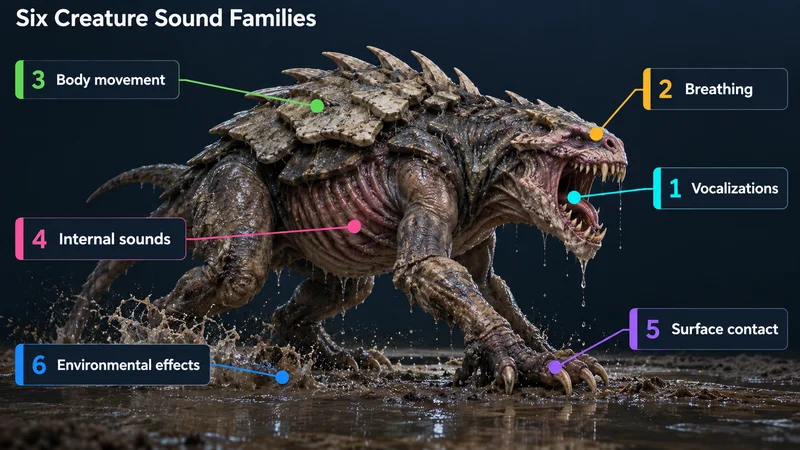
A complete creature kit draws on six sound families, each tied to a part of the anatomy you mapped out above. You'll find each of them in our Creature Sound Effects Packs and Organic Sound Effects Packs collections.
| Sound family | Biological role | Typical audible cues |
|---|---|---|
| Vocalizations | Intentional calls, warnings, threat displays, pain, or distress | Roars, shrieks, clicks, trills, guttural growls |
| Breathing | Airflow through nostrils, the throat, gills, or membranes | Inhales, exhales, snorts, wheezes, wet rattles |
| Body movement | Locomotion, posture shifts, and skeletal or muscular motion | Joint creaks, shell clicks, skin friction, muscle tension |
| Internal sounds | Involuntary biological activity inside organs and cavities | Pulses, contractions, low gurgles, spasms |
| Surface contact | Direct impact between limbs or body mass and terrain | Footsteps, claw scrapes, tail drags, body falls |
| Environmental effects | Secondary reactions triggered in the surrounding space | Splashing mud, snapping branches, shifting debris |
You don't need all six families playing at once. A tight stealth close-up might run on damp breathing and a faint spasm alone, and a full-speed charge brings in vocalizations, joint creaks, heavy impacts, and flying debris together.
Recording source material
A good source recording has texture, movement, and room for processing, even if it sounds nothing like a monster at the mic. The monster comes later, in the edit and the processing chain.
Choosing sources and recording performances
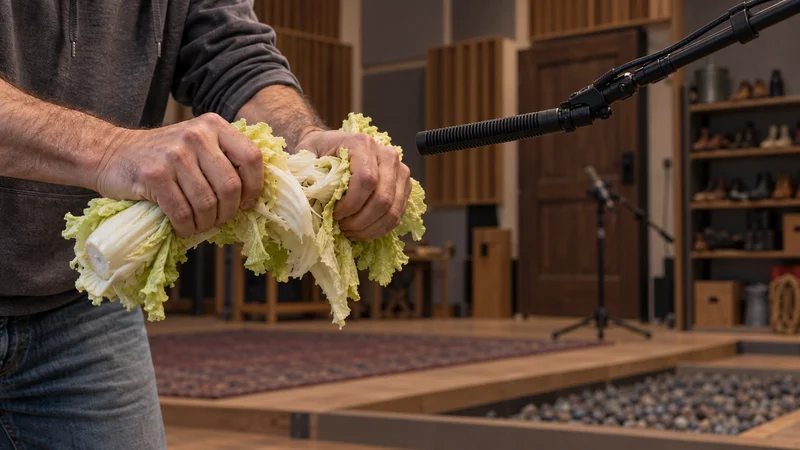
Most organic creature cues blend several sources so each take covers one element: structure, wet tissue, fluids, breathing, or motion. Your own voice is often the fastest tool in the room when you skip words and record guttural breaths, throat clicks, grunts, and wet mouth detail. When I audition props, I listen for grain, motion, and how well a take survives processing. Wet a cabbage core (regular or Napa) and twist it, and you get fleshy tears, small snaps, and fibrous pull.
Handled with care, everyday props cover a lot of biological ground:
- Grapefruits and tomatoes: crushed, squeezed, and stirred for soft flesh, bursts, and spray that work for rupturing sacs, tearing tissue, or a gelatinous crawl.
- Thick, dampened soft rubber: bent, compressed, or crumpled for dense, wet deformations suggesting heavy hide, twisting walls, or coiling tentacles.
- Bell peppers: snapped open for a hollow crack that sells a dislocating jaw, a tearing cavity, or a splitting alien carapace.
- Wet sponges: squeezed and wrung out for oozing pores, seeping fluid, and waterlogged tissue.
Figuring out how to create creature sound effects with real weight mostly comes down to blending voice, animals, props, and synths so no single source gives the trick away. On our 24-bit / 96 kHz WAV pack Biohazard - Organic Textures and Ambiences (163 sounds in 197 files), we built organic monster vocalizations from animal growls, guttural human breathing, low gurgles, and thick liquid churning. Film Foley runs on the same logic. For Jurassic Park (1993), Foley artist Dennie Thorpe used large ice cream cones for dry eggshell cracks and a cantaloupe for wet detail. Erik Aadahl told The Washington Post in 2019 that the creatures' echolocation clicks in A Quiet Place started as a stun gun zapping grapes, slowed down. Non-animal and mechanical sources fit whenever anatomy calls for them: Forest Creature Sound Effects builds tree-like beings from natural wood creaks, snaps, and breaks, and Alien Tripod Sound Effects pairs organic creature sounds with heavy mechanical movement and pneumatic steam.
Match Foley gestures to mass and state: slow, heavy pulls sell inertia; quick, irregular bursts fit a skittish organism; hesitant, off-balance motions suggest injury. Roll several takes of each gesture so the edit has options.
Capturing actions, intensities, and perspectives
One take at one distance boxes you in fast, especially on a game that needs deep variation pools. Perform each action at different speeds and force levels: bite into an apple slowly, snap off a clean piece, vary your chewing, or blow air into the bite for juicier detail.
Record very close, medium, and distant perspectives, and change the mic angle whenever it adds something useful. Very close takes isolate micro-details that would disappear from farther away. Don't toss quiet recordings too fast: boosting a faint passage in your DAW often uncovers subtle textures you couldn't hear live.
Transforming raw recordings
Raw microphone takes rarely fit an imaginary creature straight off the recorder. Clean up the edits first so noise and clicks stay out of your signal chain, then use pitch, formant, timing, transient, and texture processing to set the creature's size and feel.
Selecting and editing recordings
Editing turns long, messy takes into usable gestures before any processing:
- Pick strong takes: keep the expressive passages that are free of distracting noise or technical flaws.
- Clean up the track: cut mic handling noise, bumps, stray words or motion, excess room hiss, and dead air.
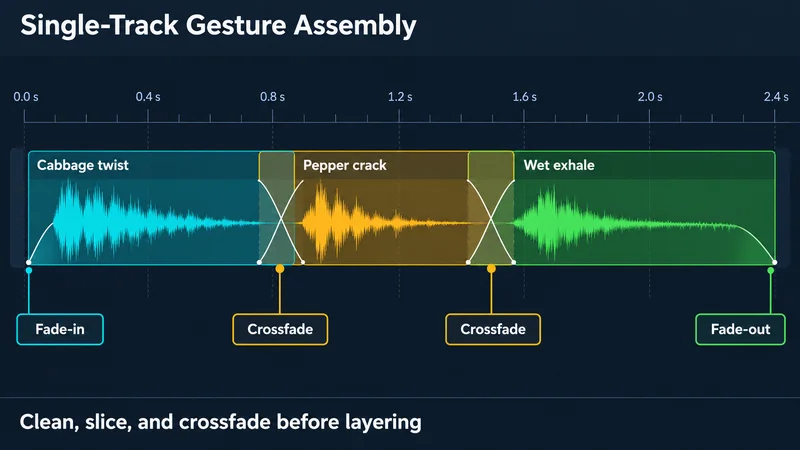
- Slice and rebuild gestures: isolate useful cracks, breaths, and wet hits from long takes, then reassemble the fragments on one track into a single action before layering.
- Smooth the edits with fades: add short edge fades and crossfades where fragments overlap so cuts never click.
Changing pitch, duration, and texture
Once the clips are clean, processing sets their scale. Pitch shifting is the fastest way to change apparent mass: pitching down crinkles from twisted lettuce leaves suggests a giant jawbone or skeletal frame, and pitching up makes a source smaller and lighter. Push pitch shifting too far on its own, though, and you start hearing the processing more than the creature.
Formant shifting keeps processed creature vocals, and any monster voice built from a human take, from turning into a cheap "demon voice effect." Formants are the resonant peaks set by the length and shape of the vocal tract (throat, mouth, and nasal cavities); shifting them makes a voice sound bigger or smaller without changing its pitch. Changing playback speed locks pitch and duration together: slow down a radish crunching between your teeth, and that snap stretches into a splitting carapace or a giant limb breaking. To match picture timing without changing pitch, use time-stretching and listen for smeared attacks and other artifacts.
Transient and texture tools dial in contact hardness. Sharpening the transients makes body hits drier and more brutal, and softening them makes flesh contact feel more pliable. Saturation adds harmonics and density, and controlled distortion pushes timbre into rougher, unrecognizable territory. Granular processing splits audio into tiny grains and reorganizes their timing, length, pitch, or overlap to stretch a short snap into a continuous or fractured texture. On Alien: Covenant (2017), supervising sound editor and sound designer Oliver Tarney and sound designer Michael Fentum started from a mantis shrimp click the picture department liked, then built the Neomorph's echolocation from dolphin and beluga calls blended with fracturing wood in Kyma. For its torso, Foley artist Andrea King worked frozen racks of ribs bought by Foley supervisor Hugo Adams, and its breaths blended a bear breathing heavily with air bubbling through mud.
Building the final creature sound
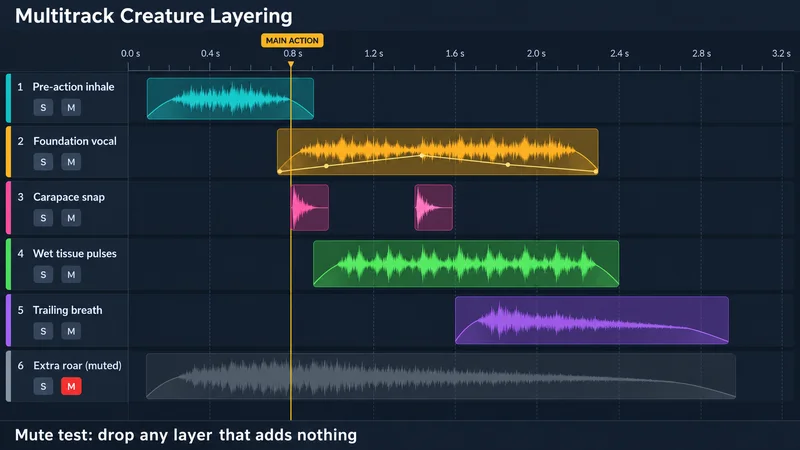
Processed clips turn into a living creature only when each track has one clear job in the timeline. Instead of dropping ten recordings on the same frame, stagger their entrances and give each one its own level and frequency range around the movement on screen.
Combining sounds by function and timing
I treat creature layering as a five-step build where timing matters as much as timbre:
- 1. Start with one foundation track: pick a base recording that makes the core action clear and shapes the cue, even if it ends up sitting level with the rest of the stack.
- 2. Add only what's missing: bring in extra tracks to reinforce tissue grain, mass, internal motion, or terrain contact. When blending animals, keep only a brief gesture or narrow frequency band from each take so no species gives itself away. In Cave Creature Sound Effects, monster vocalizations sit beside growls, rumbles, gurgles, insect clicks, and muddy cave water and each layer brings its own detail.
- 3. Slip in pre-action cues: place an inhale, throat catch, or joint creak ahead of the main moment so the effort reads before the hit lands.
- 4. Stagger phases and tails: offset attacks slightly, chain a snap into a groan with a trailing breath, and space contractions or pulses at variable intervals so organic activity never feels mechanical.
- 5. Run the mute test: mute one track at a time; if nothing useful disappears, delete it. A few layers with distinct jobs hit harder than a crowded stack fighting over the midrange.
Balancing the layers
Mixing the layers against each other is what glues separate recordings into one organism. Decide which layer leads and tuck the supporting detail underneath. When two tracks clash, pull one fader down or cut masking frequencies with EQ instead of turning everything up, and automate layer volumes from impact to release.
Set the creature's own stereo width before you pan it in the scene. Keeping the core energy centered while spreading supporting textures wider decides whether the creature feels compact or broad. Then check that the overall weight matches its size and what it's doing.
Testing the creature sound in context
Soloed studio tracks can fool you, so I always test a finished cue in the actual mix, alongside dialogue, music, and the surrounding effects.
Whatever the medium, run three checks. First, make sure you can still hear what the creature is doing, how it moves, or what state it's in through a busy mix. Second, verify that key biological details survive without getting masked; if music or dialogue buries subtle textures, rebalance volumes, simplify layers, or drop non-essential elements. Third, check that position and distance place the creature accurately relative to the camera or player.
Finish with checks for your format. On a film or TV series, verify tight sync with the movement, a natural evolution of the sound, and continuity from cut to cut. In a video game, test directly in live gameplay to confirm clean triggers, smooth state and distance transitions, and enough variation to hide repetition.
Start with one idle breath
Mute five seconds of any creature footage today and build one two-second idle breath for it before you touch an attack roar. Record a close-miked exhale, a twisted wet cabbage core, and flexed damp rubber, then stagger their timing so the breath gathers, catches on wet fiber, and settles. To drop studio layers onto your timeline right away, download Free Creature Sound Effects and Free Organic Sound Effects from our free sound effects page. Both packs are free for personal and commercial projects, as long as you credit "Designed by Bluezone Corporation" or link to our website.